
 If you are comparing outbound migration firms, you are usually not choosing between two random brands. You are choosing between two operating models for the same high-stakes decision: which residency or citizenship pathway fits your family, your capital, your timeline, and your tax profile.
This guide compares Arton Capital and Plan-B Outbound Migration Consultancy on the questions investors actually ask: program differences, long-term residency value, investment minimums, how firms help secure a second passport, reviews, tax implications, and who each firm is built to serve.
Nothing here is legal or tax advice. Rules change by country and by applicant. Always confirm current government requirements with qualified counsel before you commit capital.
What outbound migration means in this comparison
Outbound migration, in this context, means planning a lawful second residency or citizenship through government-approved investment routes. That includes:
- European Golden Visa and residency-by-investment programs
- Caribbean citizenship by investment (CBI)
- US EB-5 and similar investor visas
- Other residency programs that may lead to naturalization over time
This is not cloud migration, data egress, or IT offboarding. If your search mixed those terms, you are in the wrong category.
Understanding global residency and citizenship programs
What is a global residency program?
A residency-by-investment program grants legal residence (often with travel rights) when you meet investment, background, and documentation rules. Some programs are a path to citizenship after years of residence. Others are primarily mobility and Plan B insurance.
What is citizenship by investment?
Citizenship by investment (CBI) confers citizenship and a passport after a qualifying contribution or investment, usually on a faster timeline than ordinary naturalization. Caribbean programs are the most common comparison point for US families evaluating speed and cost.
Why wealthy families pursue a Plan B
Common drivers include:
- Mobility and visa-free travel
- Geographic diversification of risk
- Education and lifestyle options for children
- Estate and succession planning (with cross-border tax review)
- A backup if home-country policy, tax, or travel rules shift
The right program is rarely "the cheapest passport." It is the pathway that still makes sense after you model minimum investment, holding period, physical presence, exit tax, and ongoing compliance.
Arton Capital: overview
Arton Capital positions itself as a financial advisory firm focused on investment migration. Its brand line is "Empowering Global Citizenship." The firm acts as an authorized agent on multiple citizenship and residency programs and emphasizes tools, partners, and scale.
Services and strengths
- Broad catalog of citizenship by investment and residency by investment options
- Proprietary comparison tools (Arton Index, Arton Matrix, Program Match) to shortlist programs
- Certified Partner network that files and manages cases in multiple jurisdictions
- Government advisory work on program design (relevant if you care about firm depth in policy)
- Global Citizen Forum and HNWI-oriented ecosystem
Typical programs Arton highlights
Arton publishes program menus across regions. Examples commonly listed on its site include Caribbean CBI (Antigua and Barbuda, Dominica, Grenada, St. Kitts and Nevis, St. Lucia), European residency routes (including Portugal and Greece themes), Malta, Italy residency options, and US EB-5. Minimum investments vary by program and change with government rules.
Published Caribbean citizenship examples on Arton-related materials often start around $200,000 to $250,000 USD plus fees, with timelines often quoted in roughly 3 to 12 months depending on country and case complexity. Verify live numbers before budgeting.
Who Arton fits best
Arton tends to fit investors who:
- Want a global menu and digital program comparison up front
- Are comfortable working through a large partner network
- May already work with multi-jurisdiction wealth advisors
- Prioritize brand scale and tool-assisted program matching
Plan-B Outbound Migration: overview
Plan-B Outbound Migration Consultancy is a United States-headquartered consultancy focused on outbound migration for American and Canadian families. The firm has operated since 2009 and emphasizes trust, transparency, and concierge coordination rather than guaranteed outcomes.
Services and strengths
- Strategy development for Golden Visa, Caribbean CBI, and other pathways
- Concierge case coordination (documents, timelines, in-country legal teams)
- US-based accountability: Beverly Hills headquarters and named leadership
- Founding partner Calvin S. Mazlumyan, Esq., a California-licensed immigration attorney (also Series 65 investment advisor representative and licensed realtor per firm materials)
- 30-minute complimentary consultation to assess fit before engagement
Typical programs Plan-B emphasizes
Plan-B content and service pages focus heavily on pathways Americans evaluate first, including Portugal Golden Visa-style planning, other European residency routes, Caribbean citizenship options, and investor migration themes relevant to North American clients. Minimum investments depend on the country route (for example, European real estate or fund thresholds vs Caribbean contributions).
Who Plan-B fits best
Plan-B tends to fit families who:
- Want a US-based point of contact for sensitive documents
- Prefer attorney-led positioning and clear scope before capital moves
- Value concierge coordination (banking setup, appointments, renewals) beyond a program brochure
- Are comparing firms after reading Portugal or Golden Visa content aimed at US taxpayers
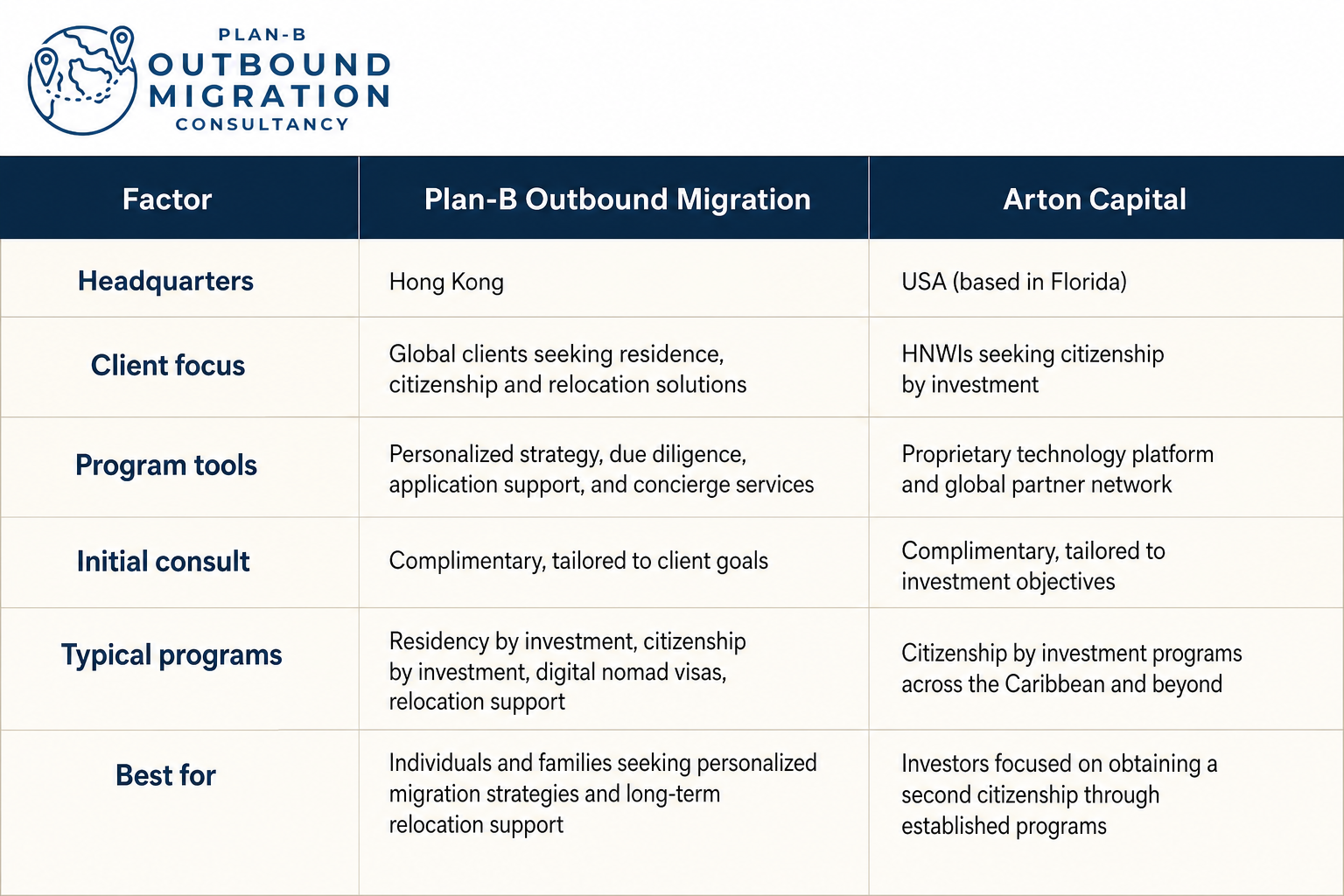
Arton Capital vs Plan-B: side-by-side comparison
| Factor | Plan-B Outbound Migration | Arton Capital |
|---|---|---|
| Core identity | US-headquartered outbound migration consultancy | Global investment migration advisory |
| Primary geography | US and Canadian families | Worldwide HNWI clients |
| Leadership signal | CA-licensed immigration attorney as founding partner | Financial advisory and authorized agent model |
| Program discovery | Consult-led strategy and education content | Arton Index, Matrix, Program Match tools |
| Network model | Coordinates in-country legal teams | Certified Partner network globally |
| Program breadth | EU Golden Visas, Caribbean CBI, EB-5 themes | Large multi-country CBI and RBI catalog |
| First step | 30-minute complimentary consultation (published) | Inquiry through global channels / partners |
| Transparency stance | Publishes "no guarantee" and diligence reminders | Emphasizes integrity and long-term relationships |
| Best for | North American families wanting US-based concierge coordination | Global investors wanting tool-driven program comparison at scale |
Key differences between major outbound migration investment programs
Programs differ more than firms differ. When people ask about "two major outbound migration investment programs," they are usually mixing firm choice with country choice. Separate them.
| Dimension | Residency-by-investment (example: EU Golden Visa) | Citizenship-by-investment (example: Caribbean) |
|---|---|---|
| Primary outcome | Residence permit; possible path to citizenship later | Citizenship and passport, subject to approval |
| Typical timeline to status | Months for residence; years for naturalization | Often months for citizenship stage (country-specific) |
| Capital type | Real estate, funds, bonds, business, donations (varies) | Government fund, real estate, or approved options |
| Mobility benefit | Schengen or regional travel rights (program-specific) | Passport visa-free access (country-specific) |
| Ongoing obligations | Renewals, minimal stay rules, compliance | Renewal fees, due diligence updates |
| Tax planning | Critical before investing | Critical before investing |
Both Arton and Plan-B can advise on multiple program types, but the program rules come from governments, not from either brand.
Which service offers better long-term residency benefits?
Long-term value depends on your goal:
- If you want fastest passport mobility and can accept CBI economics, Caribbean routes may win on speed.
- If you want EU lifestyle and a citizenship path with physical presence planning, a European Golden Visa route may win on lifestyle optionality even if naturalization takes longer.
- If you want US relocation, EB-5 or other US investor routes are a different comparison entirely.
Firm choice matters for execution quality: due diligence, document accuracy, realistic timelines, and coordination with local counsel. It does not replace program economics.
As of 2026, several European countries have tightened residency and nationality rules. Portugal, for example, has seen legislative changes that can extend citizenship timelines for some applicants. Treat any "years to passport" claim as a hypothesis to verify with counsel on the day you apply.
How investment migration firms help secure a second passport
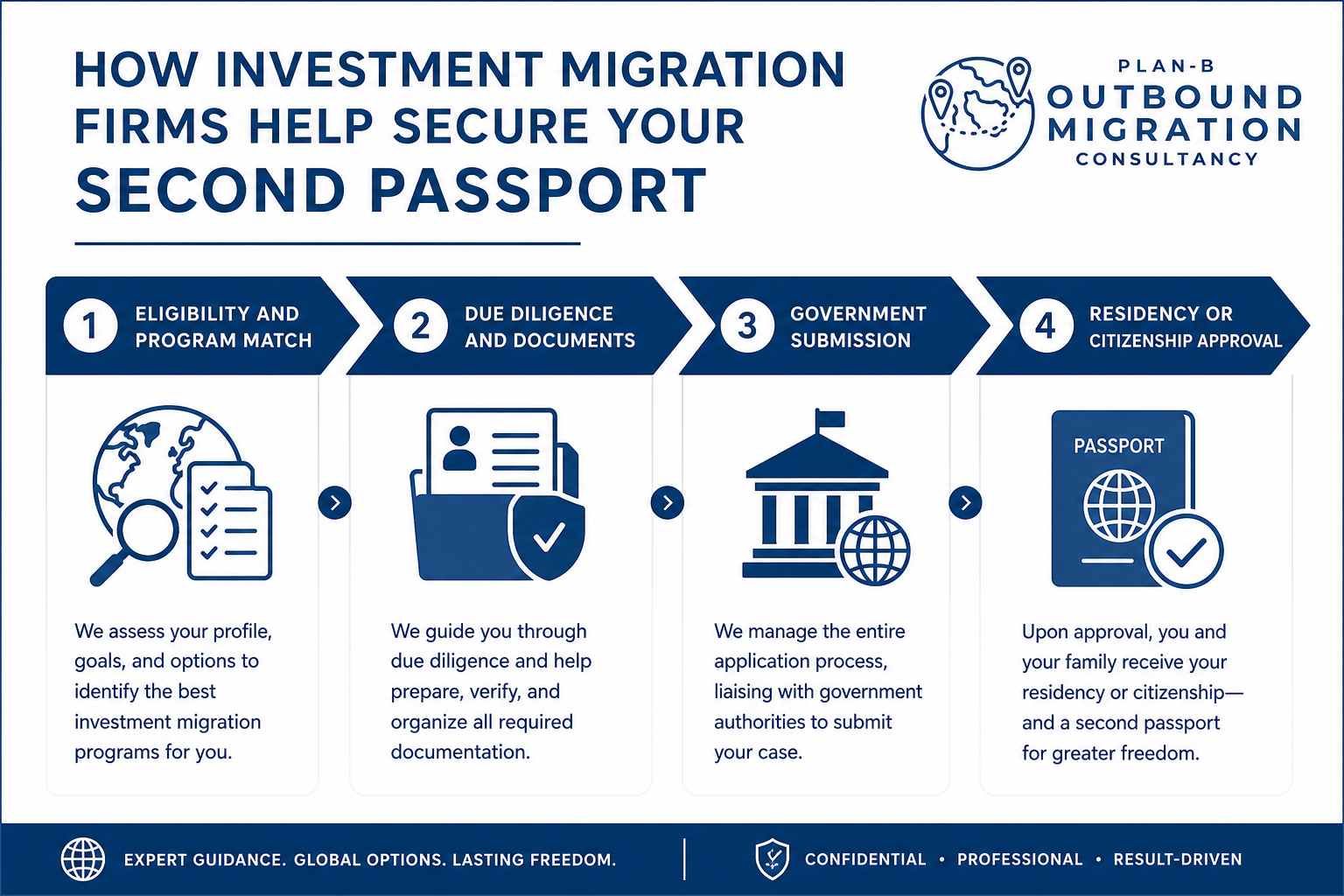 Reputable firms do not "sell passports." They help you navigate a government process:
- Eligibility and program fit (nationality, source of funds, criminal and security checks)
- Investment structure (qualifying route, escrow, property or fund compliance)
- Application assembly (translations, apostilles, government forms, local submissions)
- Approval and post-approval steps (biometrics, residence card, passport issuance where applicable)
Arton's model emphasizes digital program matching plus partner execution. Plan-B's model emphasizes US-based strategy sessions plus concierge coordination with in-country legal teams. Both can be legitimate; the difference is who owns your day-to-day communication and how you prefer to work.
How investment requirements compare (citizenship by investment)
Illustrative Caribbean minimums published in the investment migration market (verify before signing):
| Country (examples) | Published minimum investment range | Typical processing window (indicative) |
|---|---|---|
| Dominica | From about $200,000 USD | Often quoted around 3 months |
| Antigua and Barbuda | From about $230,000 USD | Often quoted around 4 to 5 months |
| Grenada | From about $235,000 USD | Often quoted around 7 to 8 months |
| St. Lucia | From about $240,000 USD | Often quoted around 9 to 12 months |
| St. Kitts and Nevis | From about $250,000 USD | Often quoted around 6 to 12 months |
European Golden Visa thresholds are usually higher and tied to real estate, funds, or other qualifying assets. A Portugal or Greece route can involve six-figure to seven-figure capital depending on option, plus legal, government, and carrying costs.
Total cost is always: qualifying investment + government fees + legal fees + diligence + travel + ongoing compliance. Compare total cost, not headline minimum only.
Typical investment options for alternative residency
Common qualifying routes include:
- Government contribution funds (CBI)
- Approved real estate purchases with hold periods
- Venture capital or government bonds
- Business investment and job creation (some countries)
- Donation or cultural heritage routes (program-specific)
Arton lists many of these across its authorized programs. Plan-B typically helps US and Canadian clients narrow to a short list (often Portugal or Caribbean first) before capital is deployed.
Reviews: where to compare outbound migration firms
There is no single official "Arton vs Plan-B" scoreboard. Use multiple signals:
- Named testimonials on each firm's website (verify they match real clients where possible)
- Third-party directories and forums (treat anonymous posts cautiously)
- Credential checks (bar licenses, registrations, company entity)
- Clarity on fees in writing before transfer
- Whether anyone promises guaranteed approval (red flag)
Plan-B publishes client quotes and emphasizes US headquarters since 2009. Arton publishes scale metrics (for example, thousands of clients served) and partner certifications. Cross-check both against your own diligence call.
Tax implications: what to plan before you apply
Tax outcomes depend on your citizenship, current residency, future residency, assets, and how long you stay in each country. Common topics investors discuss with cross-border tax counsel:
- US citizens and green card holders: worldwide reporting obligations may continue even with a second passport
- Exit tax and covered expatriate rules (US-specific scenarios)
- Tax residency days tests in the new country
- CFC, PFIC, and investment holding structure
- Estate and gift tax treaties (or lack thereof)
Neither Arton nor Plan-B replaces licensed tax advisors. A good consultancy should encourage independent tax review before you invest, not skip it.
Application process: what to expect
While details vary by country, most cases follow this arc:
| Phase | What happens | Typical duration (varies) |
|---|---|---|
| Discovery | Goals, budget, family structure, risk tolerance | 1 to 3 meetings |
| Program selection | Compare 2 to 4 routes with counsel | 1 to 4 weeks |
| Document prep | KYC, source of funds, translations | 4 to 12 weeks |
| Submission | File with government or authorized unit | 1 to 4 weeks |
| Decision | Approval, refusal, or requests for more info | 2 to 12+ months |
| Post-approval | Cards, passport, renewals, presence compliance | Ongoing |
Plan-B highlights a complimentary 30-minute consultation as the entry point. Arton highlights tool-assisted matching then partner-led filing. Ask any firm for a written scope: what they do, what local lawyers do, and what you must do yourself.
How to choose between Arton Capital and Plan-B
Use this decision grid:
| If you prioritize… | Lean toward |
|---|---|
| US-based meetings and North American client focus | Plan-B Outbound Migration |
| Global program menu and digital comparison tools | Arton Capital |
| Attorney-led US consultancy positioning | Plan-B |
| Large certified partner network worldwide | Arton Capital |
| Concierge coordination for banking and appointments | Plan-B (confirm scope in writing) |
| Multi-country lifestyle branding and forums | Arton |
You may also consult both, then retain the firm that answers clearly on fees, timelines, and who holds responsibility if a deadline is missed.
Red flags for any outbound migration advisor
- Guaranteed visa or passport approval
- Pressure to wire funds before written engagement terms
- Unclear distinction between consultancy fees and government charges
- No referral to independent tax counsel for US persons
- Confusion between IT cloud migration and residency planning
- Copy-paste timelines that ignore 2025 to 2026 rule changes in Europe
Bottom line
Arton Capital and Plan-B Outbound Migration both operate in investment migration, but they are not interchangeable.
Arton is built as a global citizenship advisory platform with broad program tooling and a worldwide partner network. Plan-B is built as a US-headquartered consultancy for American and Canadian families who want attorney-led positioning and concierge coordination on residency and citizenship Plan B routes.
The better firm is the one that matches how you work, documents scope and fees clearly, and pushes you toward independent legal and tax review before you invest.
FAQ
What are the key differences between two major outbound migration investment programs?
Programs differ by outcome (residency vs citizenship), minimum investment, processing time, physical presence rules, and tax consequences. Firms help you navigate programs; they do not set the rules.
What are the key differences between various global residency programs?
Some programs optimize for EU residence and long-term naturalization. Others optimize for faster passport mobility through Caribbean CBI. Compare total cost, timeline, travel rights, and ongoing obligations, not marketing names alone.
Which outbound migration service offers better long-term residency benefits?
Depends on your goal. European residency may offer lifestyle and EU access with longer citizenship horizons. Caribbean CBI may offer faster passport outcomes with different tax and travel profiles. Match program to goal first, then select the firm.
How do international investment migration firms assist with securing a second passport?
They help with program selection, due diligence, document preparation, submission, and post-approval steps. Approval is always a government decision.
How do investment requirements compare between popular citizenship-by-investment programs?
Caribbean programs often publish minimums from about $200,000 to $250,000 USD plus fees, with timelines often quoted in months. European residency routes usually require higher capital and longer horizons. Verify live thresholds before budgeting.
Compare the costs involved in different citizenship by investment pathways.
Add investment, government fees, legal fees, diligence, travel, and renewal costs. Headline minimums understate true cost.
Where can I find reviews comparing prominent outbound migration firms?
Check firm websites for named testimonials, independent directories, and third-party forums. Verify entity names and licenses. Avoid firms that guarantee outcomes.
How can I find reputable advisors for outbound migration planning?
Look for clear scope, written fees, licensed professionals where claimed, realistic timelines, and referrals to independent tax counsel. Start with a structured discovery call and compare two firms.
What are the tax implications of using outbound migration options?
Highly individual. US persons especially need cross-border tax planning before investing. No blog post replaces licensed tax advice.
What are typical investment options for obtaining alternative residency?
Common routes include government funds, real estate, bonds, business investment, and donations, depending on country rules.
Next step
If you are a US or Canadian family comparing Arton Capital and Plan-B, book a structured discovery call, bring your timeline and budget range, and ask for written scope before any transfer.
Plan-B Outbound Migration Consultancy publishes a 30-minute complimentary consultation and deep guides on routes such as Portugal Golden Visa planning for Americans.